Huntscape Community and Ecology Lab
PI Ellen Candler
Teaching
Dr. Candler is passionate about teaching and supporting graduate and undergraduate students in their desire to gain experience in the field, through Teaching Assistantships, and guest lecturing. Below are classes regularly taught by Dr. Candler.
Mammalogy
Fall Semester
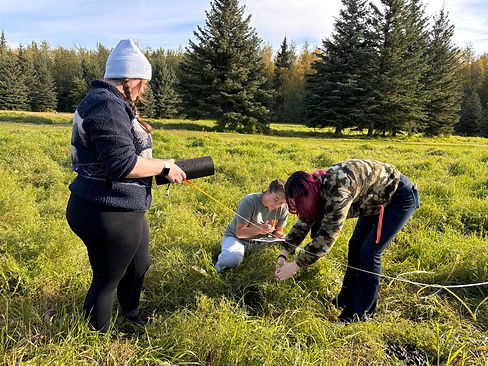
Ranging from the largest animal in the world, the blue whale, to the tiny shrews, mammals are a diverse group of organisms. They range from the marine and aquatic environments, the deserts and tundra, to the plains and alpine. Understanding mammalian diversity is critical to understanding, managing, and caring for ecosystems around the world. In this course, we explore characteristics and origins of the mammalian lineage. We also investigate the diversity of mammals' life histories, behavior, societies, and morphology. We explore the global diversity, but pay closest attention to Alaskan mammals. Labs focus on mammalian orders and families, field detection of local mammals, and identification of Alaskan mammals to genus and species.
3 credits
Survey of Wildlife Science
Fall Semester
Wildlife science careers are nearly as diverse as wildlife themselves. You could work in research, teaching, NGOs, law enforcement, or the military. In this course, you will be introduced to wildlife science through different careers in research, conservation, and management. You will also be introduced to different skills required by wildlife professionals.
2 credits


Biological Conservation
Spring Semester
Conservation Biology was developed as a field in the late 19th century in response to biodiversity loss around the globe. It has been labeled a "crisis discipline." This verbiage highlights the urgency of conserving species, genetics, and natural systems worldwide. In this course, we will investigate basic ecological, genetic, management, legal, and historical developments in conservation biology and the focused efforts to manage biological diversity resources, with a status review of important habitats and endangered species.
3 credits
Human Dimensions of Wildlife Management
Spring Semester
The human dimensions of wildlife management concerns the application of theory and methods from the social and policy sciences to address the challenges and issues of managing and conserving biological resources including wildlife and their habitats. Decisions in wildlife management are typically informed partially by dimensions that include biological knowledge (natural history, population dynamics) and the environment (habitat). However, a necessary skill of any public wildlife manager is also how to collect and understand insights from the social science. Ideally, human dimensions considerations are then integrated with biological dimensions such that agencies can make better decisions. Understanding and developing human dimensions approaches requires knowledge of how people think and act toward wildlife and ecosystems and how the management of these resources is affected. Such knowledge is essential to effectively conserve and manage biological resources in ways desired by the public. This course will explore aspects of human dimensions and will also provide exposure to people, agencies, and organizations involved in management of Alaska's wildlife resources.
